
Balloon dilation: the simplest mechanical answer.
A balloon catheter expands the narrowed prostatic urethra by mechanical force — the same principle used in cardiovascular angioplasty for decades. Next-generation columnar design now makes it viable for BPH.

How it works
A balloon is placed inside the prostatic urethra and inflated. Radial force expands the narrowed segment. No tissue is cut, no heat applied, nothing implanted.
Early balloon dilation was sidelined because durability was poor — until columnar balloon design solved for positioning and uniformity.
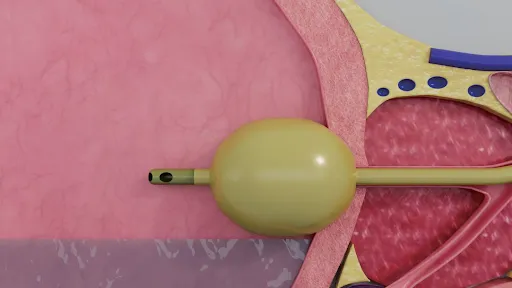
Cystoscopic confirmation & catheter positioning
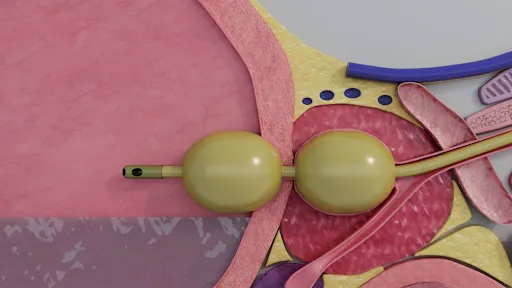
Columnar balloon dilation at prostatic segment
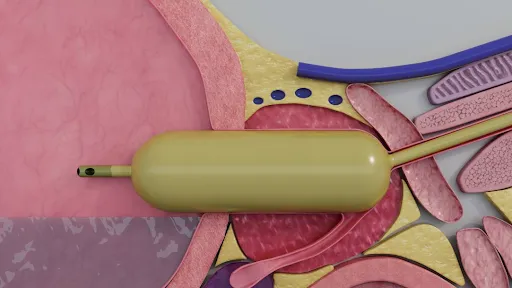
Balloon deflated & withdrawn, urethra restored
First generation
Standard round balloons. Dispersed force, short duration (6-12 month recurrence).
Nexusuro (TUCBDP second-gen)
Triple-Balloon Columnar Catheter. Precise positioning, uniform force, durable outcomes.
Pure dilation vs drug-coated
| Dimension | Pure structural dilation | Drug-coated (Optilume) |
|---|---|---|
| Mechanism | Pure mechanical expansion | Mechanical + drug (paclitaxel) release |
| Drug | None | Paclitaxel (anti-proliferative) |
| Drug-related risk | None | Potential systemic drug exposure |
| Equipment cost | Lower | Higher |
Safety and recovery
Hospital stay
Catheter post-procedure
Return to normal activity
IPSS improvement timeline
No tissue cutting
Nerves preserved
Nothing left in body
Reduces risk
Who it's for
Continue exploring
This page is for medical information reference only. Nexusuro treatment indications must be evaluated by a licensed physician. Individual outcomes may vary.